
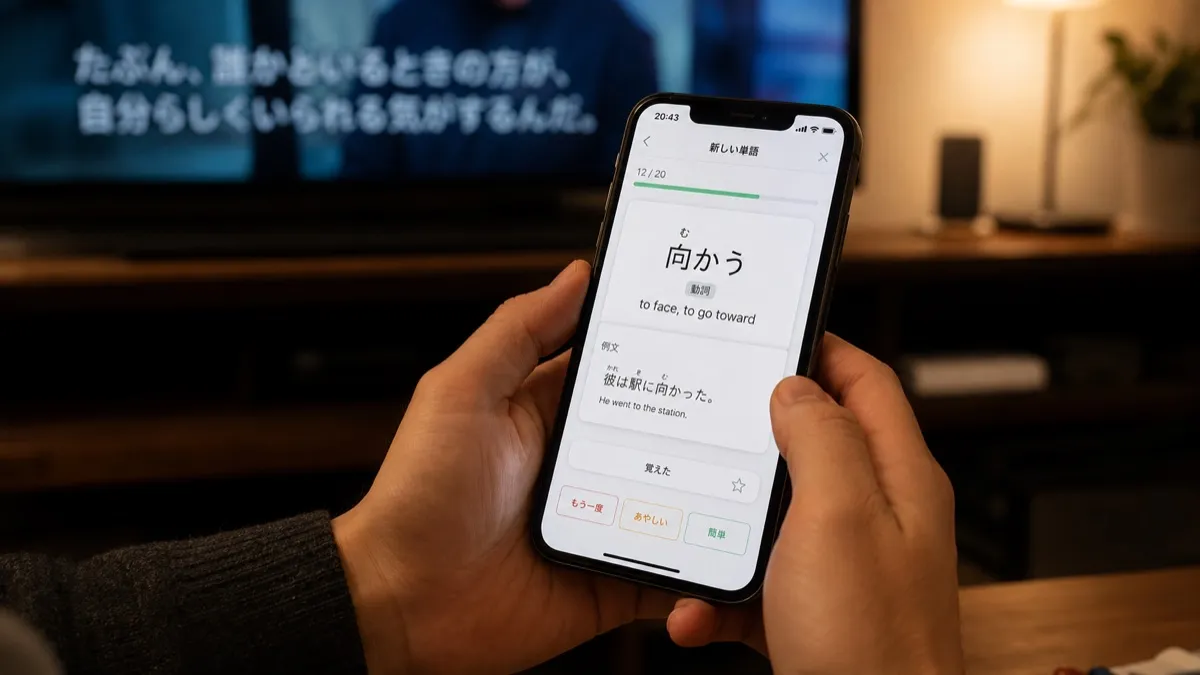
Japanese sentence mining tools fall into four jobs: finding real sentences, understanding them, saving them, and reviewing them. The best stack is the one you will use every week.
Start with What is sentence mining?, compare broad tool choices in KIKUGO vs Language Reactor vs Migaku vs Yomitan, then keep the workflow organized with the Japanese sentence mining hub.
Best Answer
Choose tools by friction. If your routine is reading web pages, a dictionary-first setup can work. If your routine is Netflix Japanese subtitles, a subtitle-to-card workflow is usually better.
| Tool need | Strong fit |
|---|---|
| Word lookup while reading | Yomitan-style dictionaries |
| Local subtitle mining | asbplayer or subs2srs-style setups |
| Netflix subtitle explanations | KIKUGO |
| Long-term review | Anki |
Best Case for Each Tool
Manual stacks are best when you enjoy configuration and want total control over fields, audio, screenshots, and subtitle files.
KIKUGO is best when you want the shortest path from a Netflix Japanese line to an explained card. It does not replace every tool. It removes the setup for the specific workflow of watching, clicking, saving, and exporting.
For the Netflix-specific cluster, see Japanese Netflix tools and Anki Japanese sentence mining workflow. To shape one sentence into a card before you commit to a full stack, try the free Japanese Anki Card Generator.
Install KIKUGO and test whether a lower-friction tool gets you mining more often.
FAQ
What tools do I need for Japanese sentence mining? You need a source of real Japanese, a way to understand sentences, a way to save examples, and a review system like Anki.
Are free sentence mining tools enough? They can be, especially for technical learners. Paid tools are useful when they remove setup and keep the routine consistent.
Where does KIKUGO fit among Japanese sentence mining tools? KIKUGO fits learners mining Japanese subtitle lines from Netflix who want explanations, saved cards, and Anki export without a complex stack.