
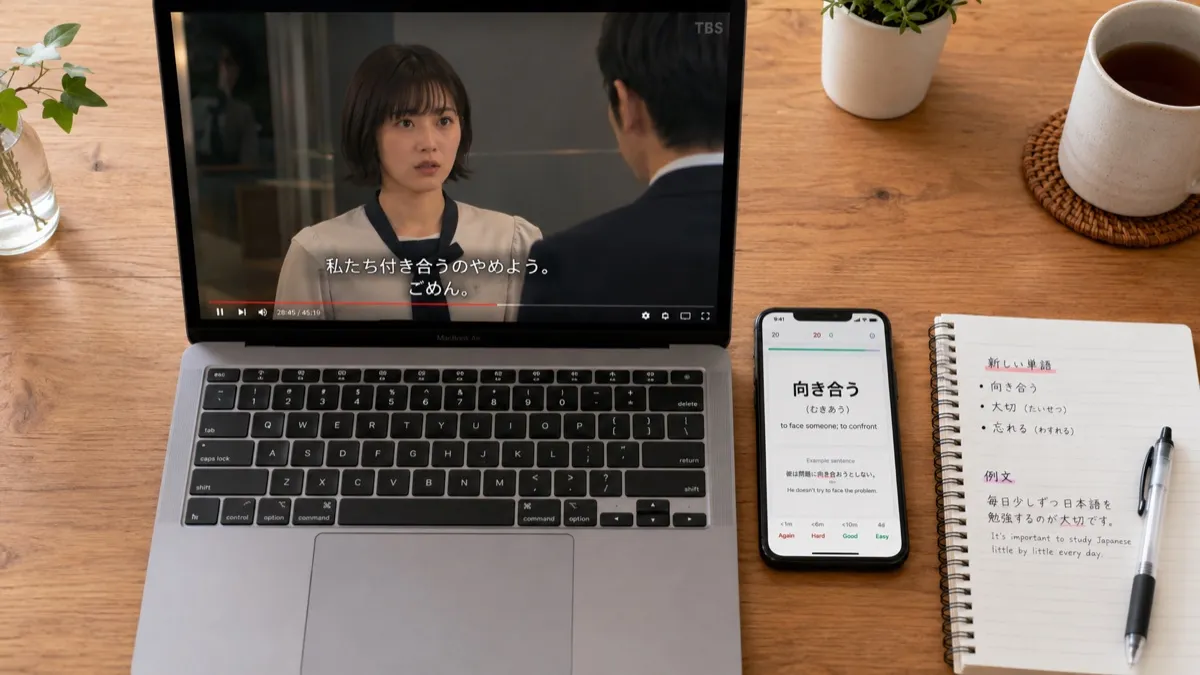
An Anki Japanese sentence mining workflow should make Netflix study repeatable: notice one useful line, understand it, save it, then review it later. The workflow fails when every episode becomes manual copy-paste work.
Use Netflix to Anki sentence deck for the full export walkthrough, improve card quality with Japanese Anki sentence cards, and review the method in What Is Sentence Mining? or the full Japanese sentence mining guide.
Best Answer
The best workflow is selective. Mine lines that are almost understandable, not every unknown sentence. Your Anki deck should feel like a trail of useful moments from the show, not a subtitle dump.
A Practical Loop
- Watch one episode with Japanese subtitles.
- Save 5-10 lines that are useful and mostly clear.
- Keep the full sentence and the explanation together.
- Export to Anki.
- Review daily before adding a large new batch.
KIKUGO compresses the capture step by letting you click Netflix subtitle lines directly and save them for export. To test the card-formatting step on its own first, use the free Japanese Anki Card Generator. If you currently generate cards from subtitle files, the subs2srs alternative guide compares that route with clicking lines directly.
If the queue has become the entire hobby, use the Japanese learning burnout reset to stop new cards, suspend low-value material, and return to a smaller deck.
Before increasing capture, choose how many Anki cards a day fit your Japanese routine, then balance Anki and Japanese immersion so reviews never replace the input that supplies useful sentences.
To compare software for this loop, see Japanese sentence mining tools.
Install KIKUGO and build a small, reviewable deck from your next episode.
FAQ
What is the best Anki Japanese sentence mining workflow? Pick sentences from input you understand, explain the line in context, save only useful cards, and keep daily reviews small enough to finish.
How many cards should I make from one Netflix episode? Start with 5-10 cards. More cards can work later, but beginners usually burn out when capture grows faster than review.
Should I mine isolated Japanese words or full sentences? Full sentences are usually better because they preserve particles, grammar, tone, and scene memory.