
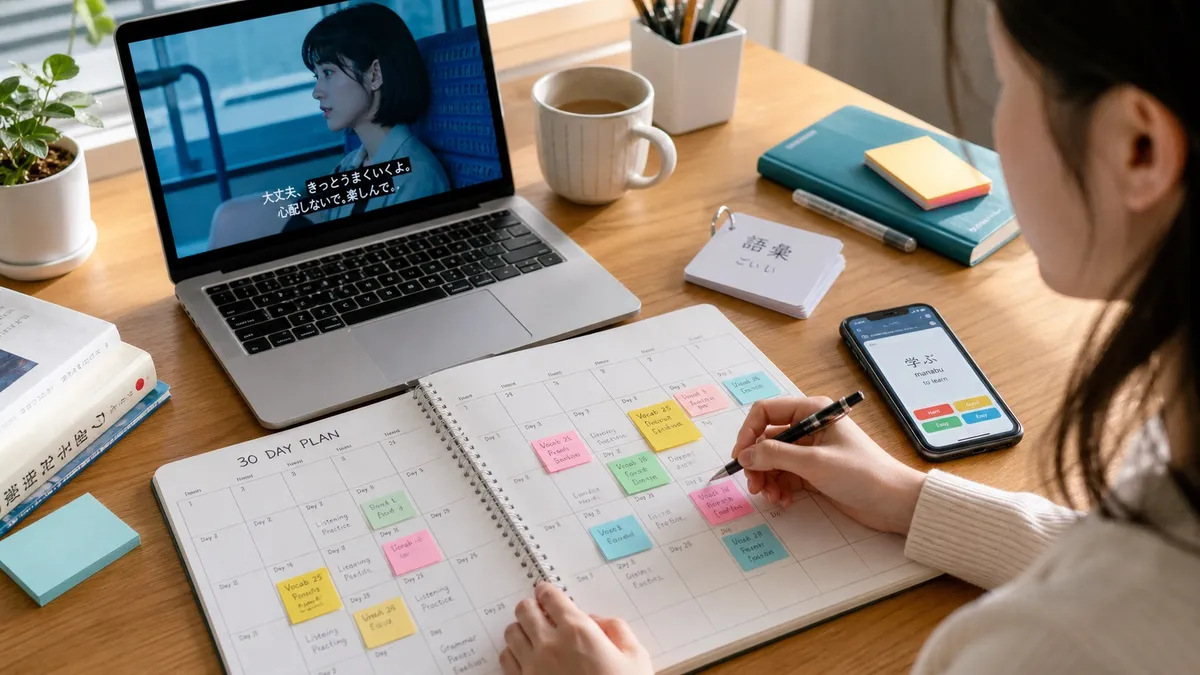
A Netflix Japanese learning routine works best when it is boringly repeatable. You do not need a heroic study schedule. You need a small loop you can repeat for 30 days: watch one manageable scene, click a few useful Japanese subtitle lines, review them later, and make the next episode a little easier.
This 30-day plan is built for that loop. It assumes you are using Japanese audio, Japanese subtitles when available, and a tool like KIKUGO to save sentence-level explanations for Anki review. If you need the full setup first, read How to Learn Japanese with Netflix.
Before day 1: choose the right show
Do not start with the hardest show you admire. Start with the easiest show you will actually watch.
Use this five-minute test:
- Turn on Japanese audio and Japanese subtitles.
- Watch five minutes without pausing.
- Ask whether you can follow the basic situation.
- If you are lost immediately, choose something easier.
- If you understand the gist but miss details, it is a good fit.
For ideas by level, use Best Japanese Shows on Netflix for Language Learners. The right show should feel challenging, not punishing.
Week 1: build the habit
Goal: finish four short sessions without over-mining.
Your daily session:
- Watch 10 minutes with Japanese subtitles.
- Click 3-5 lines that almost make sense.
- Save only the lines that teach one clear thing.
- Stop before you feel tired.
Week 1 is not about volume. It is about lowering resistance. If you finish a session wanting to do more tomorrow, you won.
Common mistake: saving every unknown word. Do not do that. A good first-week card is a sentence where you understood the scene but one grammar point or phrase completed the meaning.
Week 2: add review
Goal: pair watching with daily spaced repetition.
By now, you should have a small deck. Start reviewing it for 10 minutes a day. The review habit is what turns Netflix exposure into memory.
Your daily session:
- Review yesterday’s cards for 10 minutes.
- Watch 15-20 minutes of the same show.
- Save 5-8 useful lines with KIKUGO.
- Export or queue them for your next Anki import.
If reviews become heavy, reduce new cards. A sustainable deck beats an impressive deck you abandon.
For the mechanics, follow From Netflix to Anki: Build a Japanese Sentence Deck While You Watch.
Week 3: increase Japanese-only time
Goal: rely less on English support.
If you have been using English subtitles or dual subtitles, start hiding them for easier scenes. Use English as a rescue tool after you try Japanese, not before.
Try this progression:
- First watch: Japanese audio plus Japanese subtitles.
- If confused: replay once.
- If still confused: check English context.
- Final replay: Japanese again.
This keeps the input Japanese-first while still giving you a way back into the story. If you want a detailed subtitle strategy, read English Subtitles for Japanese Netflix: When to Use Them and How to Use Dual Subtitles for Japanese on Netflix.
Week 4: make the routine durable
Goal: turn the experiment into your normal study loop.
At this point, you should know your realistic pace. Some learners can save 15 cards per episode. Others do better with 5. The correct number is the one that lets you review every day without dread.
Use this end-of-month checklist:
- Did you watch at least 12 sessions?
- Did you review on most days?
- Did later episodes feel easier than episode one?
- Did you save sentences from scenes you actually cared about?
- Did you avoid turning every episode into homework?
If yes, keep the same loop. If no, simplify it. Shorter sessions, fewer cards, and easier shows usually fix the problem.
What to measure after 30 days
Do not judge progress by whether you understand everything. That is not the goal. Measure signs that the language is becoming less slippery:
- You recognize recurring words before checking the subtitle.
- You understand repeated character catchphrases.
- You can follow scene emotion faster.
- Your Anki cards feel tied to memorable moments.
- You pause less often than you did in week one.
These are the signals that immersion is compounding. The gains feel small day to day, then obvious when you compare week four with day one.
The 30-day routine in one page
Here is the whole plan:
| Days | Watching | Mining | Review |
|---|---|---|---|
| 1-7 | 10 minutes, easy show | 3-5 lines | Optional |
| 8-14 | 15-20 minutes | 5-8 lines | 10 minutes daily |
| 15-21 | 20-30 minutes | 5-10 lines | 10-15 minutes daily |
| 22-30 | Natural episode chunks | Sustainable number | Daily, no backlog |
The routine is simple because the hard part is not planning. The hard part is doing it tomorrow too.
If the routine starts to feel emotionally expensive, use how to stay motivated learning Japanese to lower daily friction. If reviews and immersion already create persistent dread, pause the plan and follow the Japanese learning burnout reset before rebuilding.
Before committing to the plan, can you learn Japanese from Netflix explains what passive watching misses.
Install KIKUGO before your next session, choose one show, and make the first 30 days easy enough to repeat. Install KIKUGO.
FAQ
How much Netflix should I watch per day to learn Japanese? Start with 20-30 minutes of focused watching per day, plus 10 minutes of review. Consistency matters more than long sessions, especially during the first month.
How many Netflix sentences should I save per episode? Most learners should save 5-10 useful sentences per episode. That is enough to build a deck without making reviews overwhelming.
Can beginners use this 30-day plan? Yes, but beginners should choose easy shows, use subtitles generously, and mine only short lines that are close to their current level. If every sentence is confusing, pick an easier title.
What should I track during the 30 days? Track episodes watched, sentences saved, Anki reviews completed, and one simple confidence score after each session. Those signals show whether the routine is sustainable.