
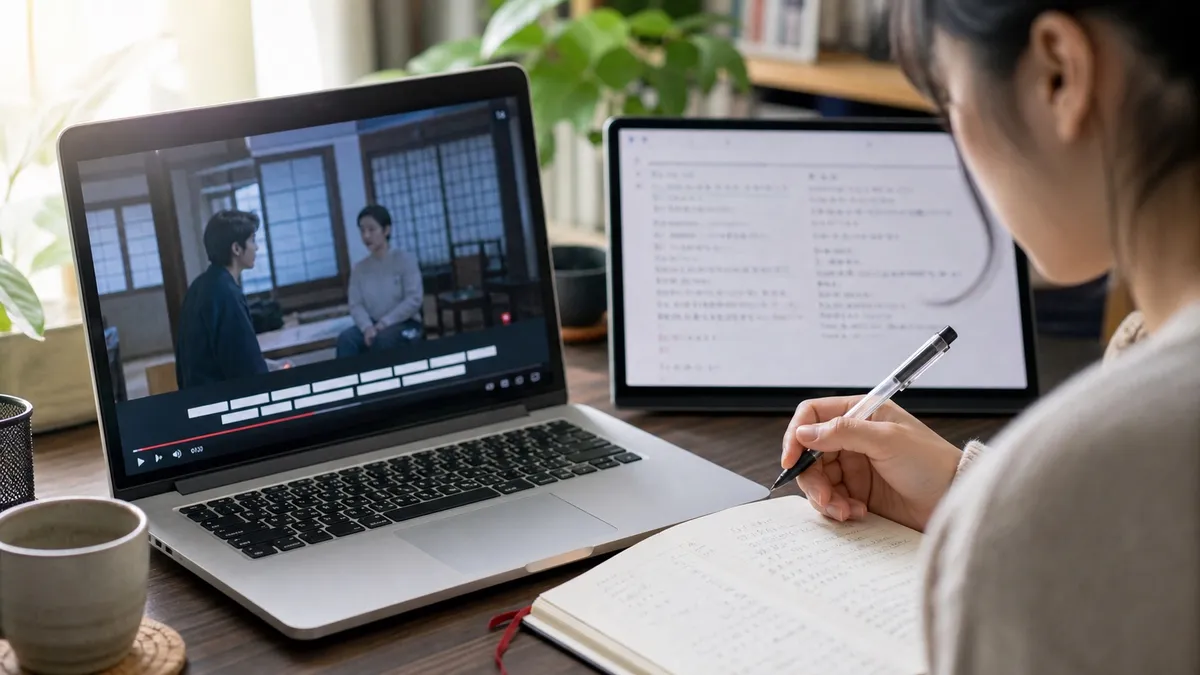
Does Japanese Netflix have English subtitles? Sometimes yes, but not reliably for every title, region, device, or profile language. That is why searches like “Netflix no English subtitles in Japan” and “English subtitles on Japanese Netflix” can lead to different answers: subtitle availability depends on the specific show, licensing, Netflix region, and language settings.
Using English subtitles with Japanese Netflix is not cheating. It is a tool. The problem is using the tool for the wrong job. English subtitles can help you understand the plot, survive a hard first episode, and recover when a scene gets too dense. But if English is always on, it can quietly replace the Japanese you meant to study.
The best strategy is not “never use English”. It is “use English only when it helps you get back to Japanese”. This guide shows when English subtitles are useful, when they slow you down, and how to transition toward Japanese subtitles without making Netflix frustrating. Start with the Japanese subtitles on Netflix setup guide if the Japanese track is not visible yet, or see the full Japanese Netflix subtitles guide for every subtitle scenario.
Quick answer: why English subtitles may be missing
If Japanese Netflix has no English subtitles for a title, the cause is usually availability rather than a broken setting. Netflix can show different audio and subtitle tracks by country, title, and account language. A show may have English subtitles in one region, Japanese subtitles in another, or only translated subtitles for selected languages.
Before changing your study routine, check the exact title’s audio and subtitle menu, then compare it with a second Japanese title. If only one title is missing English, it is probably a title-level availability issue. If every title hides English, check your Netflix profile language and device settings.
Diagnose the title, region, profile, and device
Netflix’s official language-availability guide identifies four variables worth checking: the title, region, profile, and device. Test them in that order so one missing track does not turn into random settings changes.
| Check | What it tells you |
|---|---|
| A second title | Whether the first title simply lacks the English track |
| Your current region | Whether licensing changes the languages available to the account |
| Profile language preferences | Whether English is prioritized in the playback menu |
| A supported desktop browser | Whether the original device is hiding or unable to display a track |
Changing these settings cannot make an unlicensed subtitle file appear. If English is available but the Japanese text does not follow Japanese speech, that is a different problem: read why Netflix Japanese subtitles don’t match the audio before comparing the two scripts word by word.
What English subtitles are good for
English subtitles are good for context. They tell you what is happening when the Japanese is too fast, too idiomatic, or too full of names and plot details.
Use English subtitles when:
- starting a new show and learning the premise;
- a key plot scene is impossible to follow;
- a joke or emotional line depends on context;
- you are rewatching a scene and want to confirm the gist;
- you are too tired for Japanese-only immersion but still want exposure.
That last point matters. A tired learner who watches one episode with Japanese audio and occasional English support is still doing more than the learner who skips the session completely.
What English subtitles are bad at
English subtitles are weak as a Japanese study source because they are translations. They are meant to create a smooth viewing experience, not to mirror every particle, verb ending, or omitted subject in the Japanese.
That means English subtitles can hide exactly the parts you need to learn:
- the grammar pattern that made the sentence work;
- the casual contraction a character used;
- the level of politeness;
- the difference between literal meaning and natural translation;
- the word order and emphasis of the Japanese line.
If you rely only on English, you may finish a season with a clear memory of the plot and very little memory of the Japanese.
For a Japanese-first method, read How to Learn Japanese with Netflix.
The ladder method: English to Japanese subtitles
Use English as the bottom rung of a ladder, not as the destination.
Try this sequence:
- Watch a scene with Japanese audio and English subtitles if you need story context.
- Rewatch the same scene with Japanese subtitles.
- Pause only on lines that almost make sense.
- Click useful lines with KIKUGO and save them.
- Rewatch once more without reading English.
This makes English useful because it clears the fog. Once you know what is happening, Japanese subtitles become easier to process.
If you want Japanese and English visible at the same time, read How to Use Dual Subtitles for Japanese on Netflix. Just keep the same rule: Japanese first, English second.
Beginner strategy: when English is allowed
If you are at N5 or early N4, Japanese-only Netflix can feel brutal. You may not know enough grammar or vocabulary to follow even simple scenes. English can help, but set boundaries.
A beginner-friendly rule:
- Use English for the first episode of a show.
- Switch to Japanese subtitles for repeated scenes or short clips.
- Mine only short lines with one clear learning point.
- Keep each session under 30 minutes.
At this stage, the win is not perfect immersion. The win is building a routine where Japanese audio and subtitles become familiar instead of intimidating.
Pair this with easy titles from Best Japanese Shows on Netflix for Language Learners.
Intermediate strategy: English after Japanese
At N3 and above, reverse the order. Try Japanese first. Only check English after you have made a real attempt.
The intermediate routine:
- Watch with Japanese subtitles.
- Rewind if a line matters.
- Guess the meaning from context.
- Check English only if the scene is still unclear.
- Save the Japanese line if the explanation teaches something.
This protects your attention. Your brain has to wrestle with Japanese before it receives the translation.
At this level, the most valuable lines are usually not the hardest lines. They are the lines just above your level: familiar structure, one new phrase, clear context.
Advanced strategy: English as a spot check
Advanced learners can keep English off almost all the time. Use it only as a spot check for:
- idioms;
- wordplay;
- slang;
- culturally loaded references;
- emotionally subtle lines.
Then return to Japanese immediately. If the line is useful, save it. If it was just a plot detail, let it go.
For casual expressions that subtitles translate loosely, read Japanese Slang and Casual Speech You Won’t Learn from Textbooks.
How KIKUGO helps you leave English behind
The reason learners cling to English is simple: they need explanations. If Japanese subtitles are just lines of text you do not understand, English feels safer.
KIKUGO gives you another option. Click the Japanese subtitle line and get a sentence-level explanation in context. The Japanese subtitle explanations feature shows what that workflow returns before you install it. That means you can use Japanese subtitles more often without feeling stranded.
Instead of moving from Japanese to English, you move from Japanese to explanation to review. That is a much better loop for learning.
Ready to make Japanese subtitles less intimidating? Install KIKUGO and try the ladder method on one scene tonight.
FAQ
Can I learn Japanese with English subtitles on Netflix? Yes, but only if English subtitles are a temporary support. If you read English for the whole episode, you mainly train plot comprehension. Use English to restore context, then return to Japanese audio and subtitles.
When should I use English subtitles? Use English subtitles for the first episode of a new show, difficult plot scenes, or after you have already tried to understand a line in Japanese. Avoid making English the default for every scene.
When should I switch to Japanese subtitles? Switch to Japanese subtitles as soon as you can follow the basic scene. You do not need perfect understanding; you only need enough context to keep Japanese as the main input.
Are English subtitles accurate for Japanese learning? They are useful for meaning, but they are often translations rather than word-for-word matches. Treat them as context, not as a grammar explanation of the Japanese sentence.