
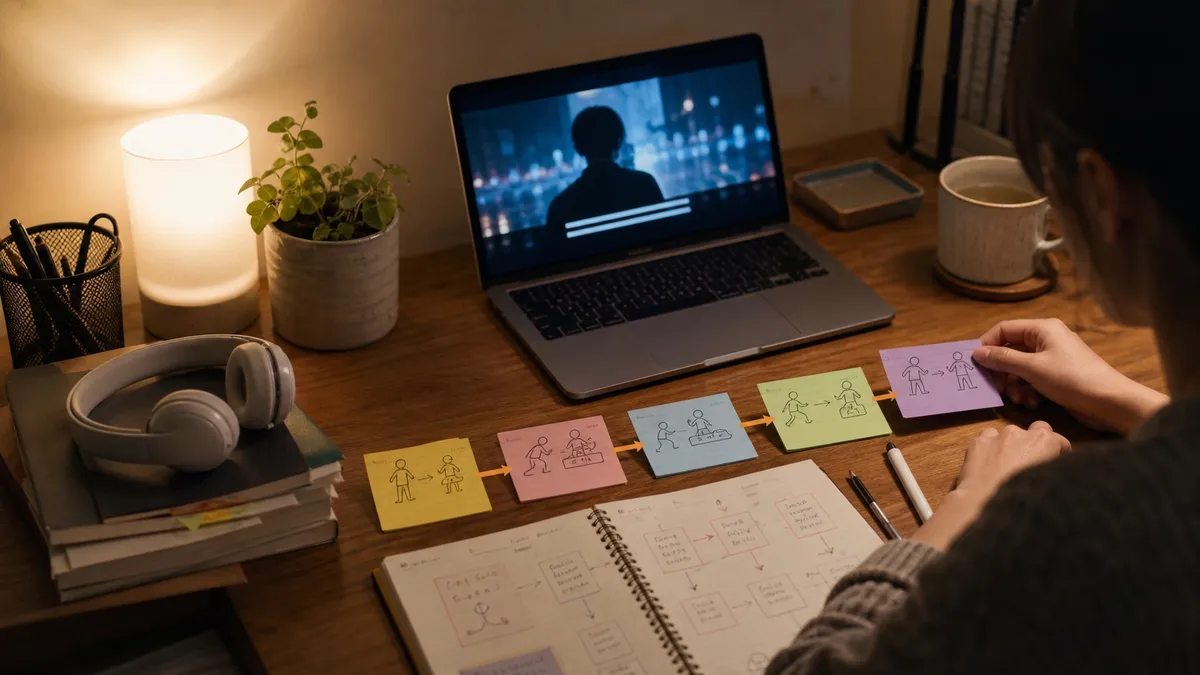
The Japanese te form appears everywhere in Netflix subtitles because it acts like a connector. It links actions, builds requests, describes ongoing states, and combines with helper expressions that add permission, completion, preparation, or trial.
Do not memorize て as one English word. Its job depends on what comes after it and on the relationship between the linked parts of the sentence.
Best Answer
Learn the sound-change chart, then recognize complete constructions such as ている, てください, てもいい, てみる, and てしまう. Subtitle context will tell you which function is active.
Te Form Conjugation Chart
| Dictionary ending | Change | Example |
|---|---|---|
| う, つ, る | って | 買う → 買って, 待つ → 待って, 帰る → 帰って |
| む, ぶ, ぬ | んで | 読む → 読んで, 遊ぶ → 遊んで, 死ぬ → 死んで |
| く | いて | 書く → 書いて |
| ぐ | いで | 泳ぐ → 泳いで |
| す | して | 話す → 話して |
| Ichidan る | Remove る + て | 食べる → 食べて |
| する | して | 勉強する → 勉強して |
| 来る | 来て | 来る → 来て |
The major everyday exception is 行く → 行って, not 行いて.
If the groups are still unfamiliar, start with Japanese Verb Conjugation in Netflix Subtitles.
Connect Actions And States
The て form can link clauses without specifying one universal relationship.
家に帰って、寝た。
I went home and slept.
窓を開けて、外を見た。
I opened the window and looked outside.
The order often follows the sequence of events, but context determines how the actions relate. For sentence parsing and omitted subjects, use Japanese Sentence Structure.
Make Casual And Polite Requests
A bare て form can work as a casual request:
ちょっと待って。
Wait a second.
Adding ください makes the request polite:
ちょっと待ってください。
Please wait a moment.
Tone matters. A sharp 待って! can sound urgent, while a soft 待って can sound intimate or hesitant. The written form alone does not capture the whole social meaning.
Describe Ongoing Actions And Resulting States
Verb + ている can describe an action in progress:
今、食べている。
I am eating now.
It can also describe a resulting state:
結婚している。
Is married.
In casual speech, the い is often omitted:
- 何しているの? → 何してるの?
- 見ている → 見てる
- 待っている → 待ってる
These are predictable contractions, not entirely new verb forms.
Permission And Prohibition
The construction てもいい expresses permission:
入ってもいい?
Can I come in?
The construction てはいけない expresses prohibition:
ここで写真を撮ってはいけない。
You must not take photos here.
In dialogue, ては may contract to ちゃ, and では may contract to じゃ. These casual shapes are common in emotionally direct lines.
High-Frequency Te Form Combinations
| Construction | Core use | Example |
|---|---|---|
| てから | After doing | 食べてから行く |
| てみる | Try doing | やってみる |
| てしまう | Finish or regrettably do | 忘れてしまった |
| ておく | Do in preparation | 買っておく |
| てくれる | Someone does for me/us | 手伝ってくれる |
| てあげる | Do for someone | 教えてあげる |
Each combination adds grammar beyond the connector. Save the complete sentence so the review card preserves who benefits, what was completed, or why the action matters.
The そうだ Grammar guide shows another form whose meaning depends on structure and context. The Japanese Grammar From Netflix hub organizes these patterns by study need, while Netflix Japanese Flashcards explains how to keep sentence context during review.
Install KIKUGO, click one subtitle containing a て form, and identify the construction before reading the translation.
FAQ
What does the Japanese te form mean? The te form does not have one fixed translation. It connects a verb or adjective to what follows, where the full construction can express sequence, a request, an ongoing state, permission, or another relationship.
How do you conjugate Japanese verbs into the te form? Ichidan verbs drop る and add て. Godan verbs change by their final kana, while する becomes して and 来る becomes 来て. 行く is a common exception and becomes 行って.
Why does ている become てる in subtitles? Casual speech often drops the い in ている, so 見ている becomes 見てる. The contraction preserves the same core construction while sounding natural in conversation.