
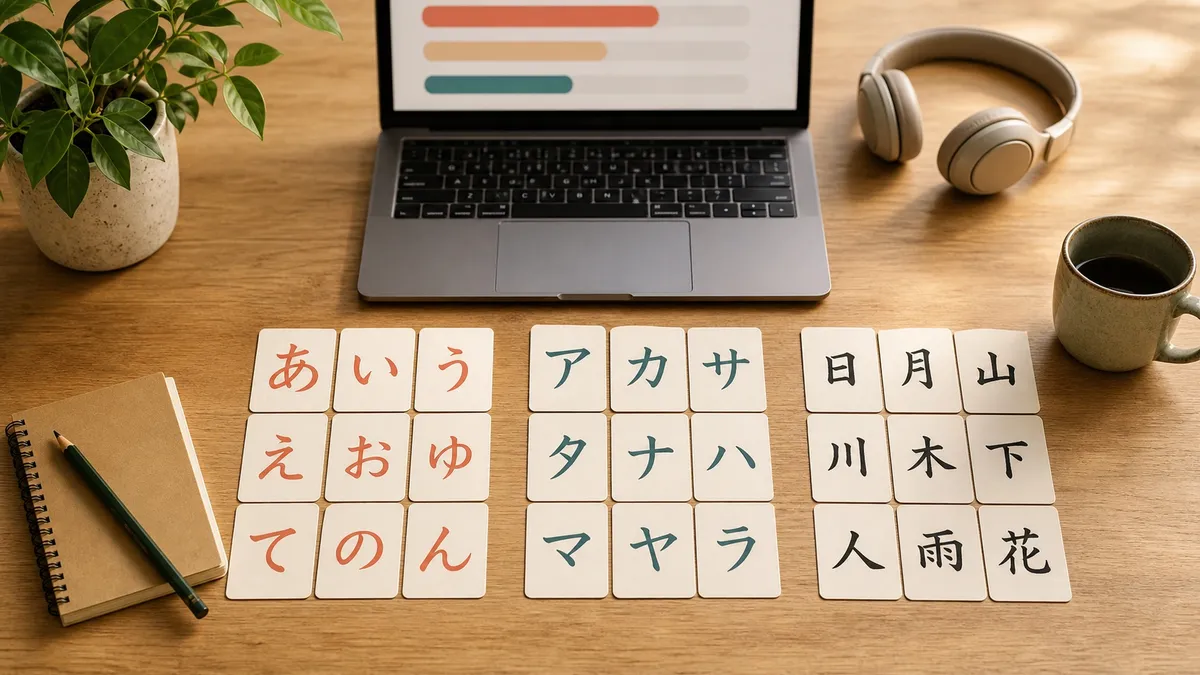
The phrase Japanese alphabet is convenient, but Japanese does not use one alphabet like English. A normal sentence mixes three writing systems: hiragana, katakana, and kanji. Romaji, the Latin alphabet, appears too, but it is not the main script of everyday Japanese.
For a learner, the useful question is not “Which alphabet is Japanese?” It is “What job does each script do, and in what order should I learn them?”
Direct Answer: What Is the Japanese Alphabet?
Japanese uses kanji for much of a sentence’s core meaning, hiragana for grammar and many native words, and katakana for loanwords, names, sound effects, and emphasis. Learn hiragana first, katakana second, and kanji gradually through words and complete sentences.
The Japan Foundation’s Irodori materials describe the same mixed system: kanji, hiragana, katakana, and romaji can all appear in Japanese, with each serving a different function.
Hiragana vs Katakana vs Kanji
| System | What it represents | Common job in a sentence | Subtitle example |
|---|---|---|---|
| Hiragana | sounds | particles, verb endings, grammar, many native words | は, を, ました |
| Katakana | sounds | loanwords, foreign names, sound effects, emphasis | アニメ, テレビ |
| Kanji | meaning-bearing characters | roots of nouns, verbs, and adjectives | 私, 見, 学校 |
| Romaji | Latin letters | signs, brands, typing support, beginner materials | Tokyo, anime |
Hiragana and katakana are both kana. Each symbol normally represents a mora, a rhythmic sound unit. Kanji work differently: one character carries meaning and may have multiple readings depending on the word.
That difference is why a Japanese line can look complicated even when it is short. You are not decoding three competing alphabets. You are reading a system whose parts cooperate.
One Sentence, Three Scripts
Consider this simple line:
私はアニメを見ました。
It combines:
- 私 and 見 in kanji for the core ideas “I” and “see/watch”;
- は, を, and ました in hiragana for particles and the polite past ending;
- アニメ in katakana for the borrowed word “anime.”
The scripts make the sentence easier to segment once you recognize them. Kanji provide visual anchors, hiragana exposes the grammar around those anchors, and katakana signals a different word family.
What Order Should You Learn Them In?
1. Make hiragana automatic
Hiragana unlocks particles, verb endings, dictionary readings, and beginner explanations. Do not stop when you can recite a chart. Build enough speed to read short chunks without naming each symbol in your head.
Use Hiragana Practice for Reading Japanese Subtitles until common chunks such as ない, してる, and けど feel like units rather than separate marks.
2. Add katakana before it becomes a bottleneck
Katakana is not optional decoration. It carries names, imported vocabulary, onomatopoeia, and visual emphasis. A learner who delays it can understand the grammar of a subtitle and still freeze on its most visible word.
Continue with Katakana Practice for Japanese Subtitles, which targets long vowels, small ッ, combined sounds, and confusing pairs.
3. Learn kanji through useful words
You do not need to “finish kanji” before reading. Start with recurring, useful characters and attach each one to a word, a reading, and a sentence. The MEXT Japanese learning handbook notes that roughly 2,000 kanji are used in daily life, but that is a long-term literacy scale, not an entrance requirement for subtitle study.
Start with the N5 Kanji List for Netflix Subtitles, then use Learn Kanji From Japanese Subtitles to turn repeated characters into contextual memory.
When Are You Ready for Japanese Subtitles?
You are ready to begin before you are ready to read every line. Use these checkpoints:
| Checkpoint | Ready-enough signal |
|---|---|
| Hiragana | you read common grammar chunks without chart lookup |
| Katakana | you can decode a short loanword in a few seconds |
| Kanji | you recognize a small set of recurring characters and can look up the rest |
| Grammar | you can identify a few particles and basic verb endings |
| Workflow | you can skip hard lines and save only one useful line at a time |
The wrong benchmark is perfect comprehension. The better benchmark is whether a line that is almost understandable can teach you one new thing.
A Subtitle-Reading Loop
- Watch the scene once for meaning.
- Replay one short line with Japanese subtitles.
- Identify which script caused the slowdown.
- Read the full line aloud.
- Learn one useful word, kanji, or grammar pattern.
- Save the sentence only if the surrounding context still makes sense.
The Learn Japanese with Netflix hub connects this reading loop to listening and review. When a mixed-script line is readable but still unclear, Japanese Subtitle Explanations can bridge the grammar, register, and scene context.
Sources
- The Japan Foundation: Irodori — Japanese characters
- Japan’s Ministry of Education: Japanese Learning and Life Handbook
Install KIKUGO when you are ready to turn a Japanese subtitle line into an explained, reviewable sentence.
FAQ
Does Japanese have an alphabet? Not in the same sense as English. Everyday Japanese combines kanji with two sound-based syllabaries, hiragana and katakana, while romaji uses Latin letters in limited contexts.
Should I learn hiragana, katakana, or kanji first? Learn hiragana first, add katakana soon after, then build kanji gradually through useful words and complete sentences. You do not need to finish kanji before reading simple subtitles.
How many Japanese characters do I need for subtitles? Start subtitles once both kana systems are readable. Kanji knowledge can then grow line by line; prioritize recurring characters and words instead of waiting for a fixed total.